Economists expect Modi to announce big-bang reforms.

'As of now, it seems like they want to tread the Vajpayee line, but the central government has to create trust.' 'It has to be vibrant and unambiguous.'
A brief report card on Modi's ministers.

Rediff.com gives you a look at newbies in the Council of Ministers

Since multilateral trade creates a stable, peaceful world, normalisation of bilateral trade between India and Pakistan will start a series of peace building measures, especially along the bordering areas of both states which is the worst affected from the on-going conflict, say Riya Sinha and Shehzad Poonawalla.
You just cannot let an institution go adrift and never reporting to any other institution and never submitting itself to any monitoring review or evaluation with regard to its functioning and particularly with regards to an institution which has dominion over the lives and liberties of citizens. That kind of total abdication of government responsibility with regard to that kind of an institution will be dangerous to democracy itself, to the people, Bahukutumbi Raghavan tells Sheela Bhatt

Will China's new military reforms endanger Xi Jinping's rule?

Single window clearances for realty must.

'We have 10 million votes, 15,000 votes per MP constituency. There are certain constituencies who will win by about 5,000 or 6,000 votes. So if we win this case, these 15,000 votes will play crucial roles in at least 50 Lok Sabha constituencies, which can change the dynamics of the entire political system,' Nagender Chindam tells Patrick Ward in an interview.
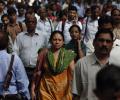
Common people expect the government to be aggressive and opt for growth related measures in the upcoming Budget.

'One big problem for the RSS is, while they spread their ideology of hard, Hindu-ised Indian nationalism, the absence of their own pantheon of modern nationalist giants. They missed out on the freedom movement quite comprehensively, in some ways comparable to the Muslim League and latter-day Communists. They have to find heroes elsewhere.' 'They borrow who they can from the Congress, like Madan Mohan Malviya and Sardar Patel, and then steal the entire lot of revolutionaries, from Bhagat Singh to Netaji, never mind that many of them were extreme leftists.'

'By beheading an Indian soldier, the Pakistan army has demonstrated its proclivity for barbaric medievalism.' 'The strategies adopted and the punishment inflicted by India must be made progressively more stringent with every new act of terrorism till the cost becomes prohibitive for Pakistan,' says Brigadier Gurmeet Kanwal (retd).
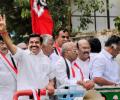
With election campaign ending in Tamil Nadu before it goes to polls on Thursday, N Sathiya Moorthy lists a few questions uppermost in the minds of voters.

The Right to Information should not be limited to right to know but it should empower every citizen to question those in power, Prime Minister Narendra Modi said on Friday.

'Electricity, better roads and uninterrupted water supply are problems for everyone in India, not Muslims alone.' 'Regional parties are solving these problems much better. And for that reason, Muslims favour regional parties.'

AAP has been vociferous since its inception and has mainly raised issues pertaining to corruption. A political party must have crisp and specific standon all issues which concern the nation not just corruption or secularism; and AAP has failed to deliver on all these counts, says Aditya Shah and Aadit Kapadia.

'With the recent challenging of the notion of the Indian Ocean Region being India's strategic backyard, China is gradually upping the ante in the maritime realm around India.'

Ajit Balakrishnan recalls some lessons from the last time people talked of 'convergence' -- the mid-1990s.
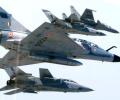
'We could quibble with each other whether there were 25 terrorists killed or 250 killed.' 'The message is more that India undertook such an aerial attack and this attack has actually changed the paradigm.' 'The change in paradigm is that India has shown by the surgical strike in 2016 and the aerial strike of 2019 that we will not just sit back and tolerate terrorism which killed so many of our people.' 'We will hit back and by hitting back we will raise the costs of such activities.'
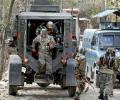
The military continues to battle difficult circumstances in Kashmir. Let's not add to their woes by spreading half-baked stories, factually incorrect posts and inaccurate articles.
Chief economic advisor Arvind Subramanian discusses the Budget, goods and services tax, Centre-state relationship and larger issues facing the economy

The system envisaged under the FRDI Bill, if implemented properly, would help improve the efficiency of capital allocation without harming consumers, and without risking the stability of financial firms, says Ajay Shah.

Instead of a consumption stimulus the government must address the NPA issue with a war footing and invest in infrastructure, affordable housing and exports, says Sanjeev Nayyar.

SBI data shows the per-capita payouts for scheme have shot up this year.
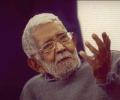
When Rajni Kothari pointed towards a new democratic alignment in India.
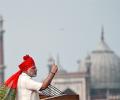
'Independence Day has been India's annual general meeting. For the most part, it has been a forgettable experience of ritual observances. Not so this year... Mr Modi instead presented what I call a moral balance sheet of India,' says Shreekant Sambrani.
De-scaling of businesses, job losses and subsequent impact on disposable incomes has created negative sentiment among traders, business owners and workers alike, says Abhishek Waghmare.

'This is not a Sanjay Baru or Natwar Singh type of book. It's not a memoir. It's not a book to reveal conversations, real or imaginary. This is not a book to position myself at the centre of the world.' Jairam Ramesh on his stint as environment minister.

If the drop in sales over the past two years is anything to go by, India's dream of putting seven million electric vehicles on road by the end of this decade has come a cropper.
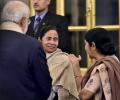
Prime Minister Narendra Modi has positioned himself as a credible partner for Bangladesh. He has scored by getting West Bengal Chief Minister Mamata Banerjee to travel with him to Dhaka, says Srinath Raghavan

IDS-2 and raids to uncover black money stash keep receipts flowing

China's malfunctioning stock markets remained semi-frozen.
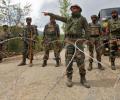
The RSS chief's comment that if war broke out, the military would not be ready for at least six to seven months is correct as it faces a shortfall in training and alertness and an even greater lack of funds for defence preparedness, notes Ajai Shukla.

Indian economy about to take-off
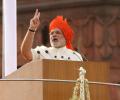
Prime Minister Narendra Modi's maiden speech from Red Fort last Independence Day outlined some grand programmes. Shehzad Poonawalla does a quick check on the progress made.

'Those who have seen the functioning of the Modi government in Gujarat know that the issues related to Hindutva and issues of economy and growth function simultaneously.' 'Modi's politics are based on the understanding of the middle-class consumer society which is in pursuit of material aspirations.' Sheela Bhatt/Rediff.com reveals the Modi government's economic and political plans for the year ahead.

It is time to take a few macroeconomic risks to kick start the growth.

'Is there any harm in studying the history of India? This is not a regressive stand. The Vedas and Upanishads should be included in our textbooks,' says Dinanath Batra.
Duty cut on raw material imports are not likely.

There is much work to be done to design a good GST.
 © 2026 Rediff.com - Advertise with us - Disclaimer - Privacy Policy - Sitemap - Feedback - About us - Terms of use - Grievances